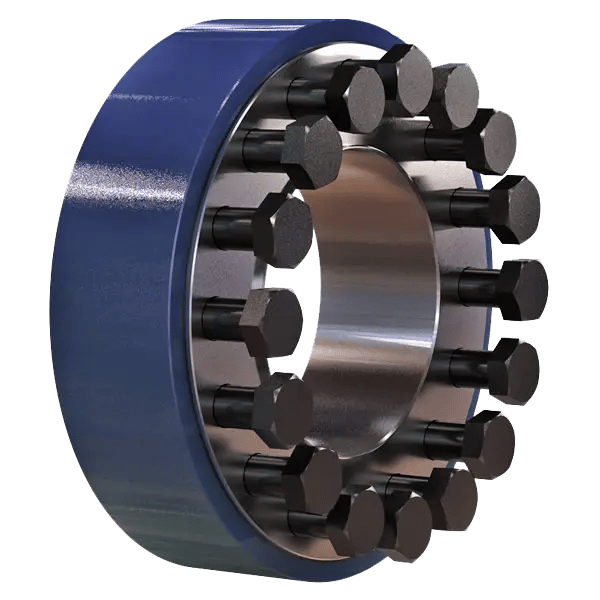
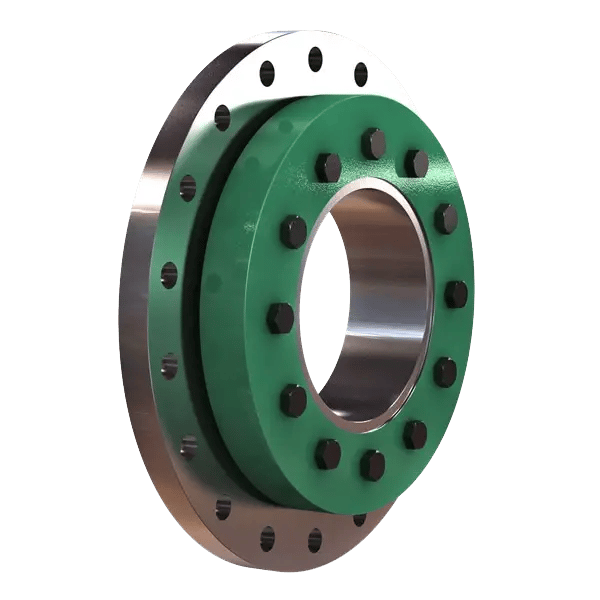
With mounting flanges/external clamping elements from the "AFS", "AF-12", "AF-22", and "AF-23" series, disc-shaped components such as brake discs, cable pulleys, and belt pulleys can be securely and backlash-free connected via friction. Connection to cardan shafts is also easily possible. Mounting flanges from the "AF-12", "AF-22", and "AF-23" series consist of a conical pressure ring and a conical inner part.
The operating principle is comparable to that of two-piece shrink discs (position-controlled). This means that by tightening the screws, the pressure ring is drawn axially onto the inner part. The use of conical surfaces reduces the inner diameter of the inner part, thereby exerting radial pressure on the shaft. Unlike two-piece shrink discs (position-controlled), mounting flanges of the "AFS", "AF-12", "AF-22", and "AF-23" series clamp directly onto the shaft. The clamping force applied by the external clamping element creates a friction-fit connection at the contact surfaces between the inner part and the shaft.
The internal parts of the mounting flanges also feature deburring threads due to their shallow conical angle. This allows for safe and easy disassembly at any time. Like two-piece shrink discs (displacement-controlled), mounting flanges have a precisely defined insertion path. This simplifies assembly without the need for a torque wrench. Compared to other friction-fit connections, the transmissible torque of mounting flanges is not solely determined by the applied pressure of the conical functional surfaces. The connecting bolts also have a significant influence on the transmissible torque due to the design of the mounting flanges. One reason for this is that mounting flanges, unlike other external clamping elements, are part of the force flow. The transmissible forces are thus transmitted from the attachment through the external clamping element to the shaft and vice versa. Therefore, the design of the bolted connection must be given particular consideration when using mounting flanges.

 Search